
Arkansas Court Docket Searches
Every Arkansas court docket search works best when you begin with the paper that names the court. A case number is the strongest match. A party name will do if the number is unknown. Common names return more noise, though. County and court location matter too. Circuit Court and District Court keep separate files. Not every District Court publishes case information online. A statewide result can point you to the right place. But the filing court's clerk holds the full docket and the official copy.
Run the public case-information system first for a broad look. When an event, document, or current court date is missing, narrow the court. Then ask that clerk for the local record.
- Choose the case, participant, or organization search that fits the information on the court paper.
- Enter the case ID or citation number as printed; formats vary across courts and years.
- Add county and court location when more than one court serves the area.
- Read filings, events, and any future date as separate docket information, not as a certified document.
- For the complete docket or a certified copy, contact the correct clerk through the county directory.
Search ARCourts Fields for Arkansas Cases
Search ARCourts, the Arkansas Judiciary's case-search screen, lets the public search free of charge. It offers several modes: case, participant, participant detail, and organization or case description. The dropdown menus for county, court location, case type, and docket code are dynamic. The values shift with the live system.
Trust the options the screen actually shows. A county listed in one mode does not guarantee that every court or case type is available online. The public interface publishes no universal required-field rule.
| Field or Control | Type | Requirement and Use |
|---|---|---|
| Search by / Cases | Selector or tab | Required status unspecified; choose case, participant, participant detail, or organization mode. |
| Case ID or Citation Number | Text | Format varies by court; copy the identifier from a filed paper or citation. |
| First, Middle, Last Name | Text | Optional status not stated; middle name may be an initial or full name if on file. |
| Organization or Case Description | Text | Search an organization name or part of a case description. |
| Date of Birth / Driver's License | Date or text | Participant-detail filters match only when the value exists in the court record. |
| Start Date / End Date | Date | Detailed search uses a filing-date range; no maximum span is published. |
| Case Type / Docket Code | Dropdowns | Dynamic court-specific options; a complete public list was not located. |
| County / Court Location | Dropdowns | Use these to narrow multi-court counties; menus are dynamic and not a coverage guarantee. |
| Search / Clear | Buttons | Run the query or clear its controls; current public help states no universal result limit. |
A Search ARCourts result can list parties, the judge, filings, charges and dispositions, future events, judgments, and some linked documents. Options on the live screen may shift as courts update local systems. Open the Arkansas statewide case-search page to see the public search interface itself.
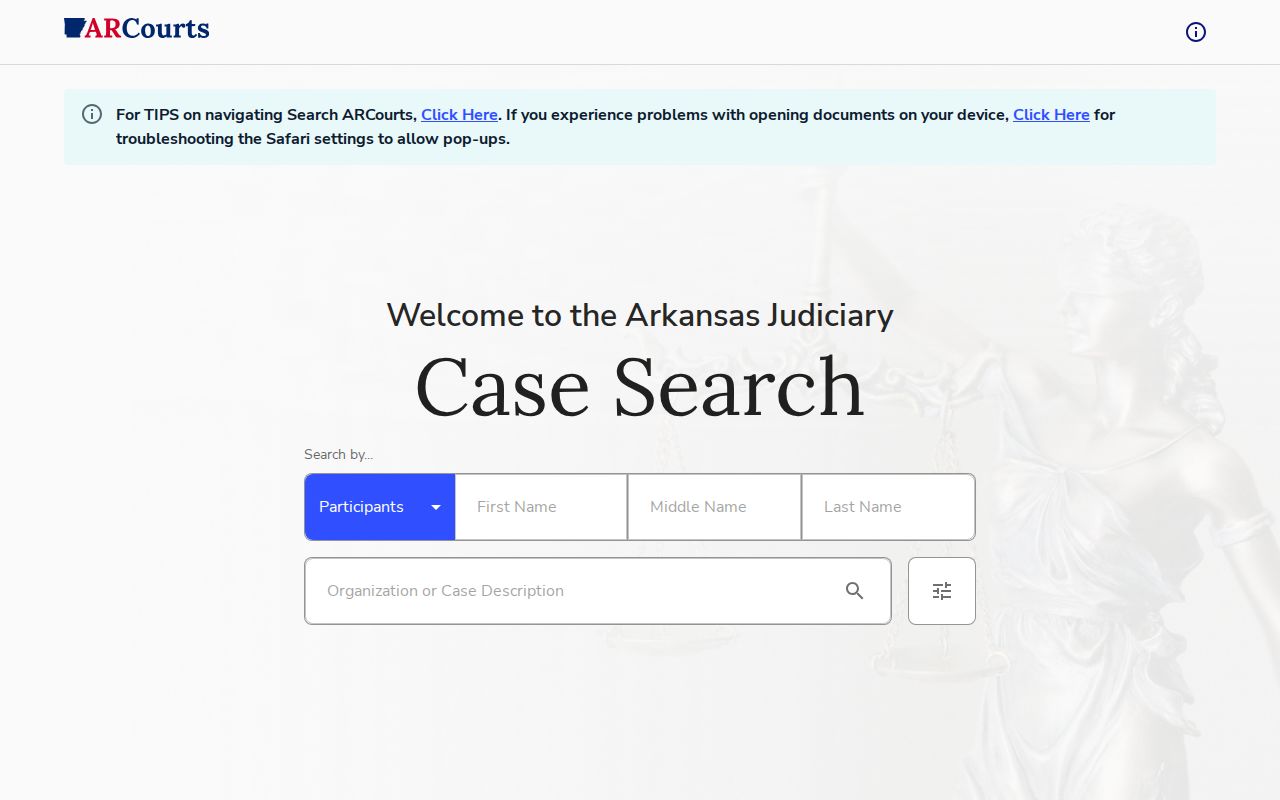
The blank interface is the public starting point; it holds no case or person information.
The Statewide Case Search in Arkansas
Search ARCourts is the public front end for case information stored in the judiciary's Contexte environment. Every Circuit Court uses Contexte. Even so, the AOC says most, not all, Circuit Courts publish additional case information through the statewide search. Only some District Courts participate. The docket search reaches statewide. It is not a complete warehouse of every court file.
A portal entry may show participants, judge, filings, charges, dispositions, future events, and judgments. It is not the official record. Contexte also does not store all document images. A case can appear while its pleading or order image stays unavailable. The Arkansas court structure page explains how the statewide search connects to local case systems.
Why Arkansas Court Cases Go Missing Online
An empty result screen does not prove a case never existed. A District Court may simply skip statewide case-detail publication. An older matter may predate that court's Contexte start. It may never have been imported. Short name queries miss matches. An incorrect court-location filter can hide a case in a county with multiple courts.
Access status and document imaging create their own gaps. Under Administrative Order 19, a sealed case may not be acknowledged at all. An open one can show a filing title with no linked image. When the portal looks empty, read the court printed on the summons or citation. Then call that clerk. When a case shows but a document does not, ask whether it was scanned. Ask whether you can inspect it. Treat any docket search result as a starting point, not proof that every local record is online.
Arkansas Courts and Their Dockets
Arkansas runs a statewide ladder of courts. Each docket stays with the court that received the matter. Circuit Court is the general-jurisdiction trial court. It splits into criminal, civil, domestic-relations, probate, and juvenile divisions. District Court takes traffic tickets, misdemeanors, ordinances, preliminary felony matters, and limited civil claims. Appeals build a separate record at the appellate level.
Let the court name on the case paper choose the clerk for you. A county name alone may not identify the right District Court location.
| Court | Docket Covers | Where to Search |
|---|---|---|
| Circuit Court | General-jurisdiction criminal and civil matters, family, probate, and juvenile cases. | Search ARCourts when available; Circuit Clerk for the complete file. |
| District Court | Traffic, misdemeanors, ordinances, preliminary felonies, civil claims up to $25,000, and small claims up to $5,000. | Search ARCourts if participating; otherwise the named local court clerk. |
| Arkansas appellate courts | Appeals, briefs, argument dates, records on appeal, and opinions. | Appellate Clerk of the Courts and appellate court resources. |
| Federal courts | Federal civil, criminal, and bankruptcy matters outside the state system. | Federal clerk and PACER/CM-ECF. |
The AOC's Circuit Clerk directory lists county contacts and names each judicial circuit. District Court boundaries can be city-based, countywide, or multicounty, so confirm the actual location before you call.
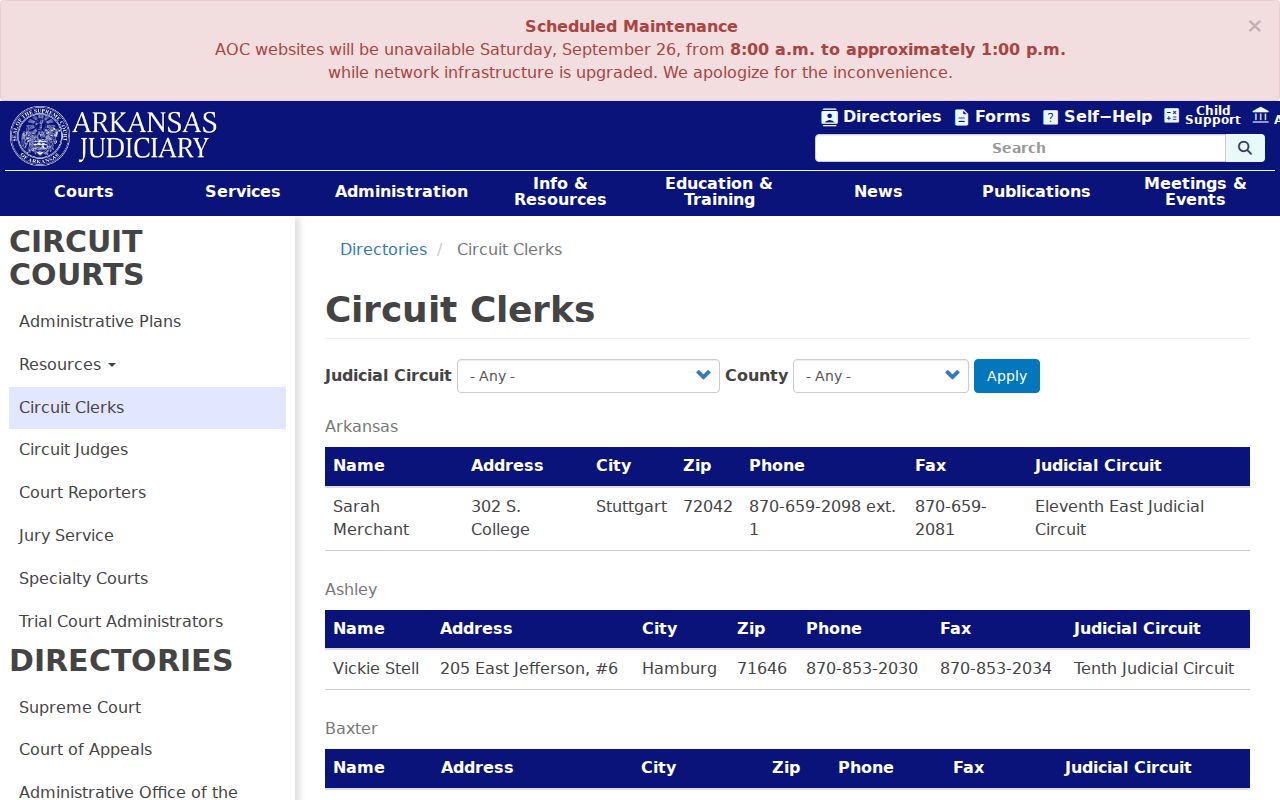
The directory leads to the office that keeps each county's Circuit Court file. A District Court matter may sit with a separate local clerk.
From Contexte to the Arkansas Public Docket
Arkansas runs three separate systems, and each does a different job. Contexte is the case-management backbone for Circuit Courts plus some lower courts. Search ARCourts pulls the public view of that case information. Tybera eFlex is different still. It is the filing gateway for eligible state-court cases, not a place to run a public case lookup. A document filed through eFlex can show up as a docket event while no public image appears. The document system may not have scanned it. Access rules may also block viewing.
E-filing has grown in steps. It started as a Pulaski pilot in 2012. It reached every Circuit Court on March 8, 2023. The AOC paused adding District Courts to Contexte in 2022 to build a replacement. In April 2026, the Build initiative showed a beta to selected clerks and judges. It aimed first at criminal and traffic needs in limited-jurisdiction courts. That beta is not statewide District Court coverage. File through Tybera eFlex, and run public searches in Search ARCourts.
Inside an Arkansas Court Docket
A single case result in an Arkansas court docket can mix identity fields, filing entries, events, and outcome data. What the public actually sees depends on the court's participation, the case type, security settings, and whether documents were imaged. Case numbers follow no one statewide pattern across Arkansas trial courts, so bring the full Case ID or citation number printed on your court paper.
Read docket entries with care. A listed filing marks an event; it is not the filing itself. Likewise, a judgment entry may summarize a decision without a clerk-certified judgment document behind it.
| Case ID and Court | Identifier, case type, county, court location, and sometimes a Circuit division. |
|---|---|
| Participants | People or organizations associated with the case; name roles and labels depend on the case. |
| Filings and Events | Chronological entry titles and dates; a title does not prove that the document image is attached. |
| Future Event | An upcoming setting may be listed, but a later reset or court notice can change it. |
| Charge and Disposition | Charges are allegations; plea, judgment, or disposition entries describe later court action. |
| Document Link | Some open entries link to images; imaging and access restrictions vary by court and record. |
Need an official docket sheet, a court order, or a certified copy? Go to the clerk who holds the file. A printout of a search result is not a substitute for the record itself.
Arkansas Docket Terms in Plain Language
Search ARCourts uses labels such as case information, filings, events, and case details. One word can point to a database field. It can also describe a court action, so weigh it with its date and context. The AOC has published no complete public dictionary of docket codes. Treat these labels as a starting point, not a formal glossary.
- Filing date
- When a paper or case was submitted to the court; it may differ from a hearing or decision date.
- Future event
- A scheduled court event shown in available case information; confirm a change with the court.
- Disposition
- A recorded resolution or status. It can apply to a charge or case and should be read with later entries.
- Judgment
- The court's formal decision or order, which may require a clerk copy to see the full text.
- Case security
- An access setting that can limit public search results or documents.
- Bind-over
- Movement of a preliminary matter to another court, which can create a second docket and identifier.
Internal Contexte security codes like CSR or SIR are not a public event glossary. They are not charge results. Users may never see them in Search ARCourts at all.
An Arkansas Court Date May Be Local
The Arkansas Judiciary calendar offers a statewide overview of court-wide events and selected appellate activities. It is not a daily trial calendar for every Circuit or District Court. A specific court date for one case may surface in Search ARCourts, a local calendar, a posted courthouse docket, or a notice from the court. A coordinator's schedule may list it too. When dates conflict, trust the most recent court notice. Or call that court's coordinator or clerk for the answer.
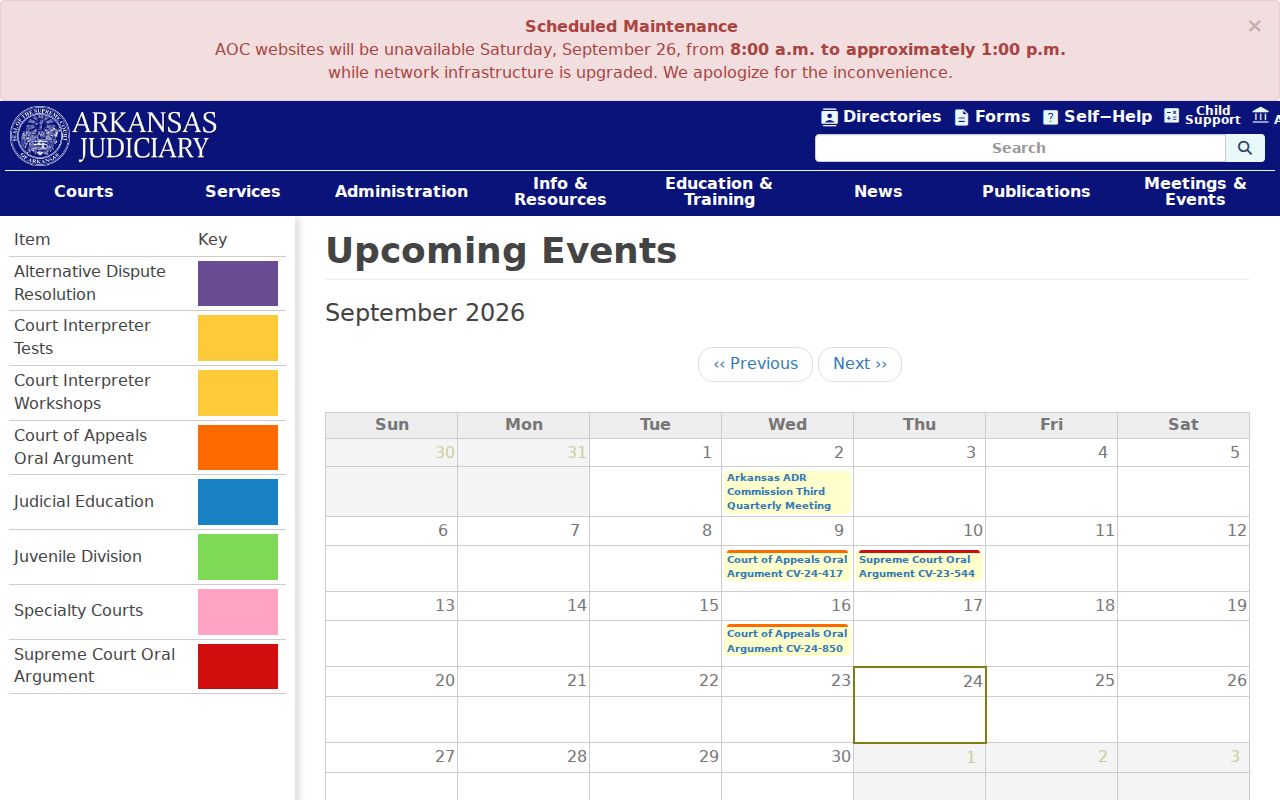
For a trial setting, work from the court named on the case. Ask its coordinator or courtroom clerk to confirm the current date, time, and location before you head out.
Arkansas Court Caseload by the Numbers
How busy are Arkansas courts? The AOC's 2025 annual report offers hard numbers for calendar year 2024. Circuit Court handled 184,611 filings and closed 180,614 cases, a 98% clearance rate. That is a systemwide measure of flow, not a promise about any single case's wait.
The division breakdown shows civil filings at 54,807 against 49,439 dispositions. Criminal filings came to 46,810, with 49,132 dispositions. District Court volume was far larger: 942,381 filings and 783,129 dispositions. Those district tables can count citations or charges rather than unique cases. So they don't line up with the Circuit totals. The AOC 2025-26 annual report and map lists 75 counties, 28 judicial circuits, and 126 Circuit judges. Its figures run current through August 2026. Every number in the tally strip keeps its year and unit attached.
Docket Access Laws in Arkansas
Two frameworks govern Arkansas court records. The Arkansas FOIA, Ark. Code Ann. §25-19-101 et seq., opens public records held by state and local bodies. It also generally limits an ordinary FOIA requester to an Arkansas citizen. Arkansas Supreme Court Administrative Order 19 is the rule aimed squarely at court records. It governs court-file exclusions and remote access. So an online docket search does not have to show everything a person could inspect in person.
Do not assume a FOIA label unseals a case. Is a public filing missing online? Ask the clerk where to inspect it or how to request it. Excluded information follows the procedure in the current order. Juvenile and sealed records carry extra statutory protections on top of that.
Arkansas access authorities
Ark. Code Ann. §25-19-101 et seq. sets the general state Freedom of Information Act framework, including the usual response and copy-cost rules.
Arkansas Supreme Court Administrative Order 19 governs public and remote court-record access, with defined exclusions and court-controlled access decisions; Administrative Order 21, §11, requires filers to redact specified personal identifiers.
Arkansas's juvenile code supplies separate confidentiality rules; adult criminal sealing is governed by Ark. Code Ann. §16-90-1401 et seq.
The Arkansas Appellate Docket Is Separate
An appeal opens a brand-new case at the appellate level. The trial docket may record a notice of appeal, record preparation, or transmission. Meanwhile, the Arkansas Supreme Court or Court of Appeals tracks briefs, motions, argument, and opinion under its own identifier. The county Circuit Clerk keeps the originating record. The appellate Clerk of the Courts handles appellate filings and copy questions.
The Court of Appeals schedule is not a county hearing calendar. Arkansas moved to official online appellate opinions in 2009. The Reporter of Decisions publishes opinions apart from the trial docket. Tracing a case's full path can mean checking both the trial-court record and its appellate docket.
Arkansas Specialty Courts Keep Local Calendars
Arkansas runs its specialty courts inside the regular court system. It offers no separate statewide case-search tool. The AOC recognizes several program types. Those include adult and juvenile drug, DWI, veterans treatment, family treatment, mental-health, HOPE/Swift, and alternative-sentencing programs. Its program snapshot counts programs. The tally: 49 adult drug courts, 16 juvenile drug courts, 14 DWI courts, and 16 veterans treatment courts. Those are program counts. They say nothing about people or open cases. Every specialty docket sets its own eligibility and review practices locally. Juvenile dockets keep juvenile confidentiality limits. An adult treatment docket follows ordinary access rules plus any order tied to the case. The AOC specialty-court program page carries the statewide program information. For a specific court record, ask the local Circuit Clerk.
Arkansas Traffic Tickets Use eTraffic
eTraffic handles Arkansas traffic tickets for participating courts. It is a citation lookup and payment route, not a full traffic-docket database. The AOC's September 2026 list named 46 eligible court or location entries. That falls short of the state's 75 counties. It also leaves out some District Court spots. A new citation can take up to one week to transfer into the system. To search, pick the court. Enter a first and last name. Then supply either a citation number or the driver's-license/state-ID with date-of-birth alternative. The AOC eTraffic participation page links the eligible court list and payment guidance. One caution applies. Under the portal notice, paying may waive appearance and trial and count as a guilty or no-contest plea. Read the citation and the court's instructions before you pay.
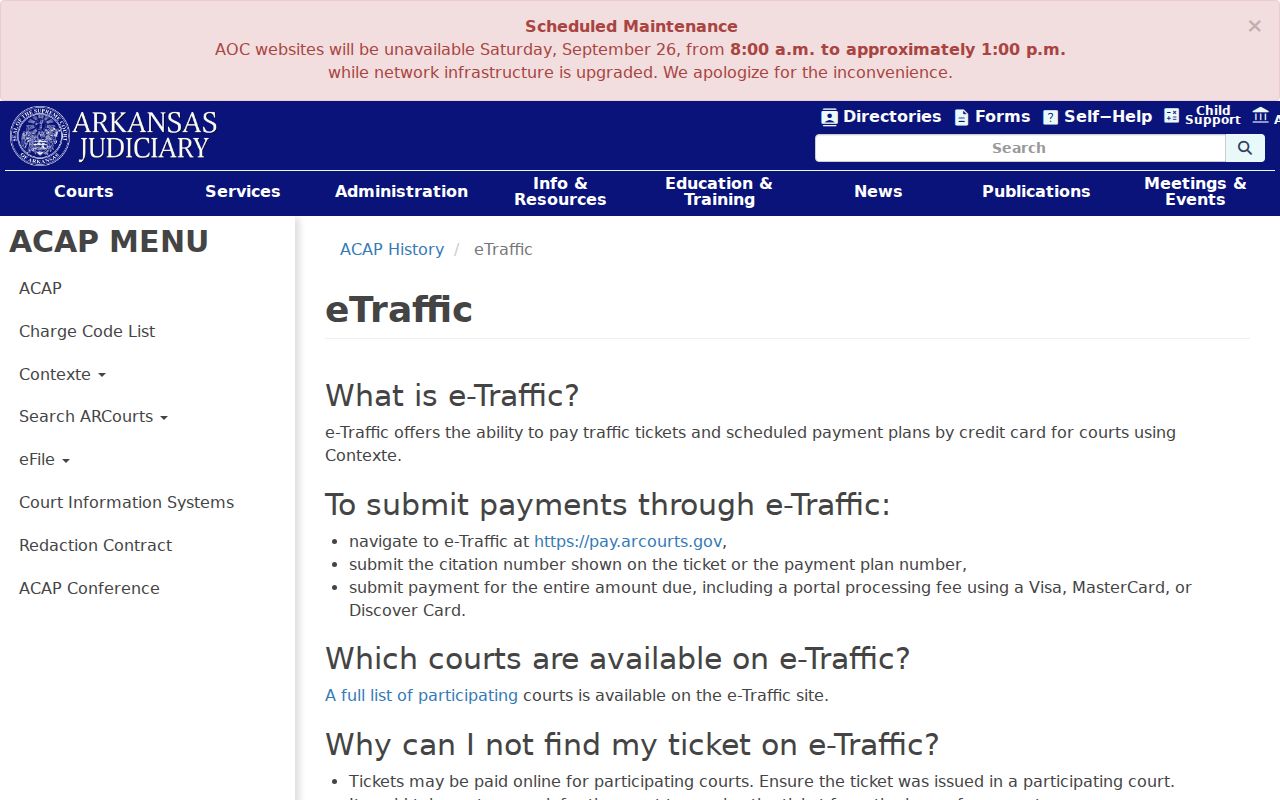
No match in the lookup? Call the court printed on the ticket, and use the county directory to find its local route.
Arkansas Federal Dockets Use PACER
Federal cases never show up in Search ARCourts. Arkansas sits in two federal districts, Eastern and Western. It also has a separate Bankruptcy Court. Federal civil, criminal, and bankruptcy dockets run on CM/ECF and PACER. Appeals go to the U.S. Court of Appeals for the Eighth Circuit. A state case and a federal case can involve the same events. They still stay separate court files. The Eastern District federal court page posts court and clerk information. In either district, the federal clerk's system is where a docket search starts.
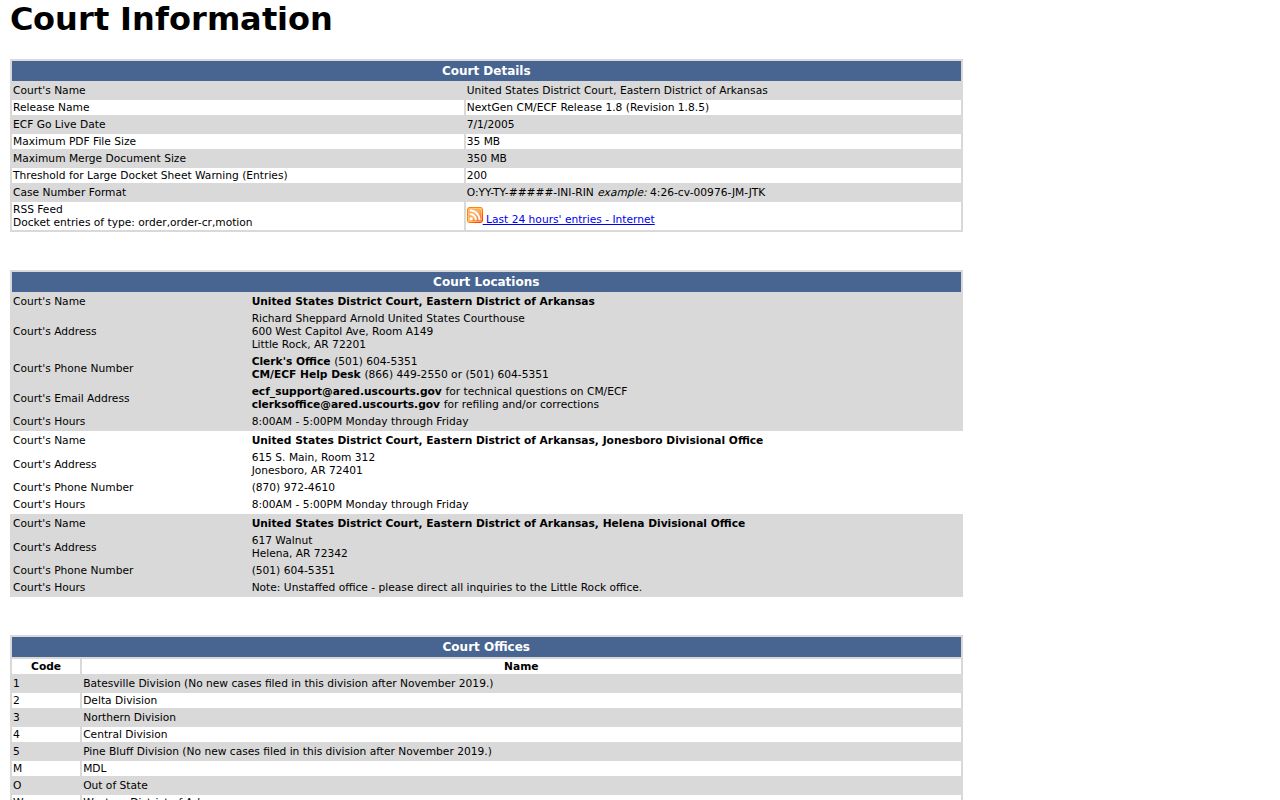
The Eastern District page identifies a federal CM/ECF route, separate from Arkansas state-court search.
Federal docket charges are separate from Arkansas court-copy fees. As of September 2026, PACER charges 10 cents per page for most electronic documents, capped at $3 per document except transcripts; search results and transcripts have different pricing rules. Usage of $30 or less in a quarter is waived. PACER has announced a temporary increase to 12 cents per page and a $40 quarterly waiver threshold beginning January 1, 2027. Check the official pricing terms and the 2027 change announcement before planning a federal records search.
The Western District federal court website provides the separate federal court and clerk path.
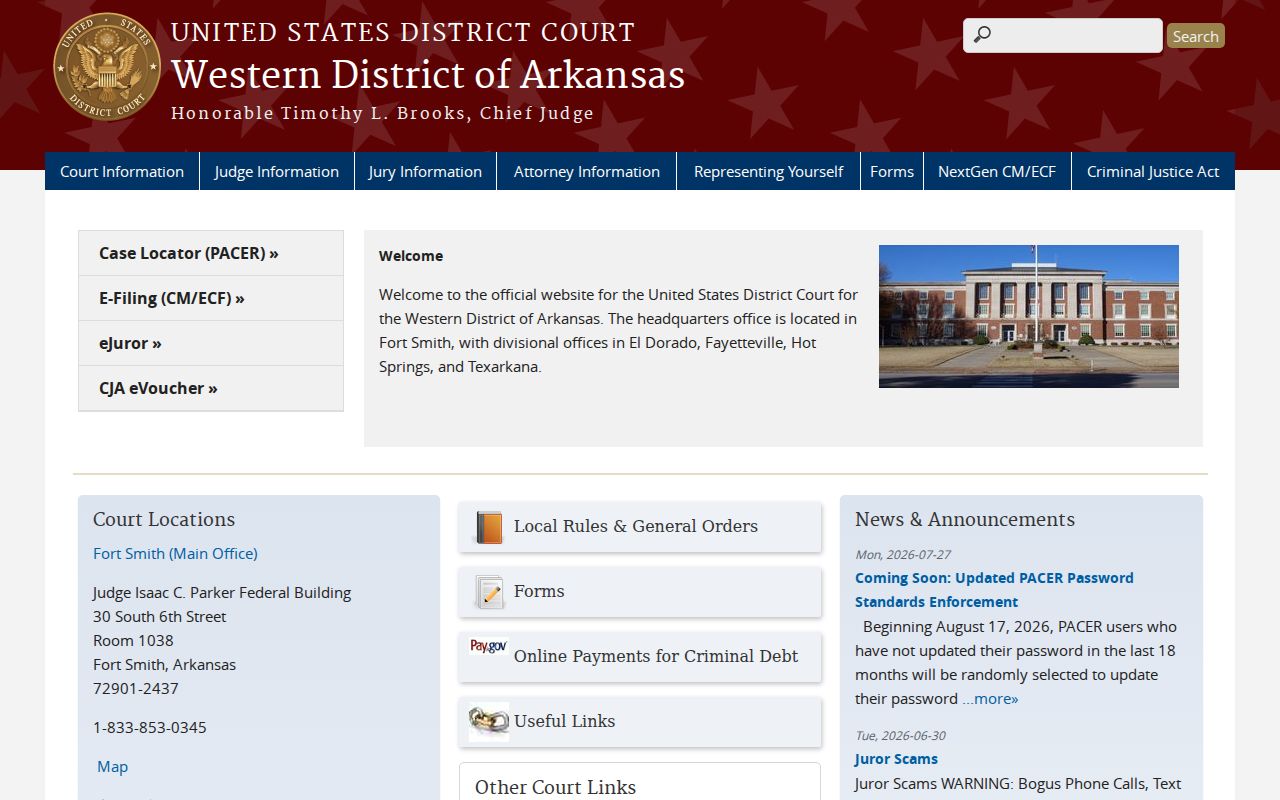
The Western District website routes users to its federal court information and filing services. The official PACER price page spells out the charge rules for electronic searches and documents.
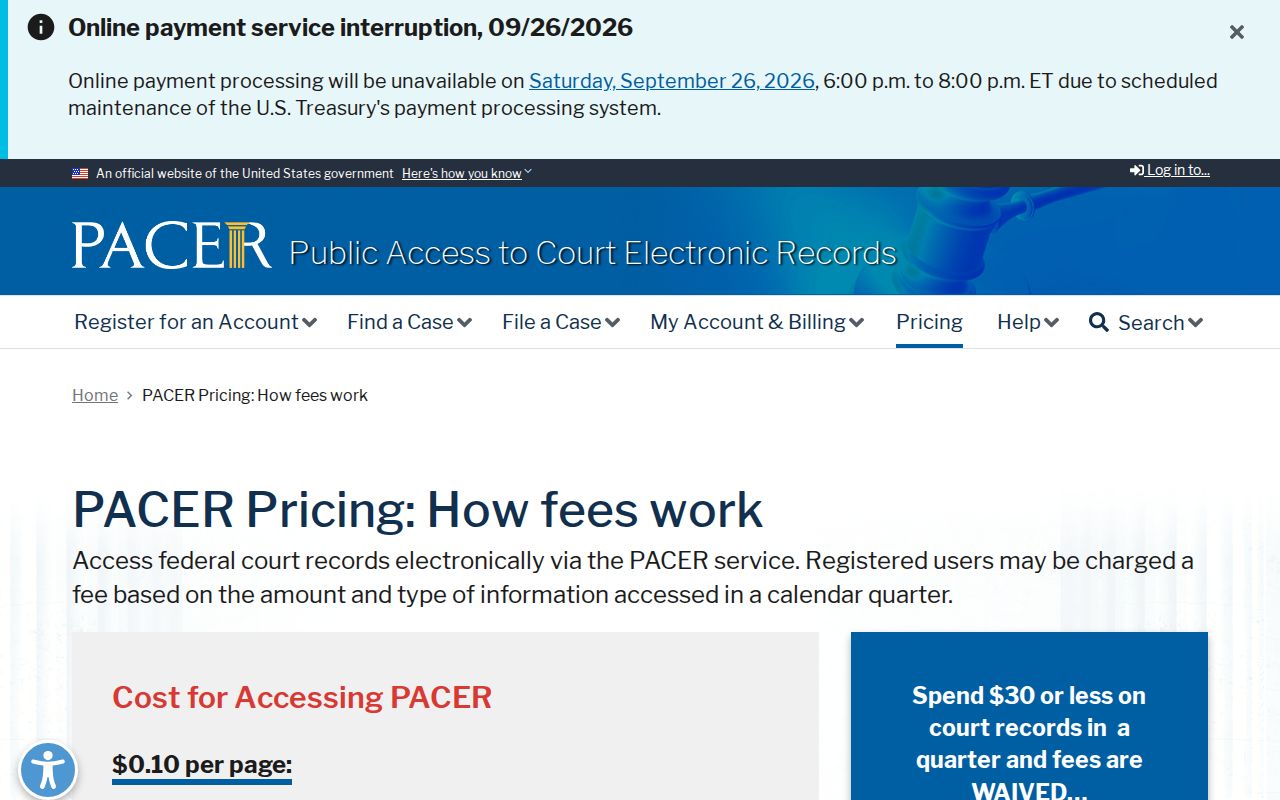
Don't confuse federal online document charges with a Circuit Clerk's state-court certification fee.
Arkansas Court Dockets by County
The docket sheet stays with the court that filed the case. County and court location help you find the right clerk. The featured county links point to local hub pages. Those pages cover major population centers. Two counties have more than one county seat or Circuit Court location. Check the case paper and court-location details instead of routing by county name alone.
Pulaski County
Little Rock · capital county and a major Circuit Court hub.
Benton County
Bentonville · one of the largest and fastest-growing Northwest Arkansas counties.
Washington County
Fayetteville · a major regional and university center in Northwest Arkansas.
Faulkner County
Conway · a central Arkansas growth center with Circuit and District matters.
Saline County
Benton · an adjacent central Arkansas county with separate Circuit and District routes.
Sebastian County
Fort Smith and Greenwood · dual county seats make court location important.
Craighead County
Jonesboro and Lake City · a regional center with two county seats.
Garland County
Hot Springs · a major central Arkansas county with Circuit and District courts.
Want every option? Browse the full directory of all 75 Arkansas counties and open the county-level court docket site for the place where the case was filed.